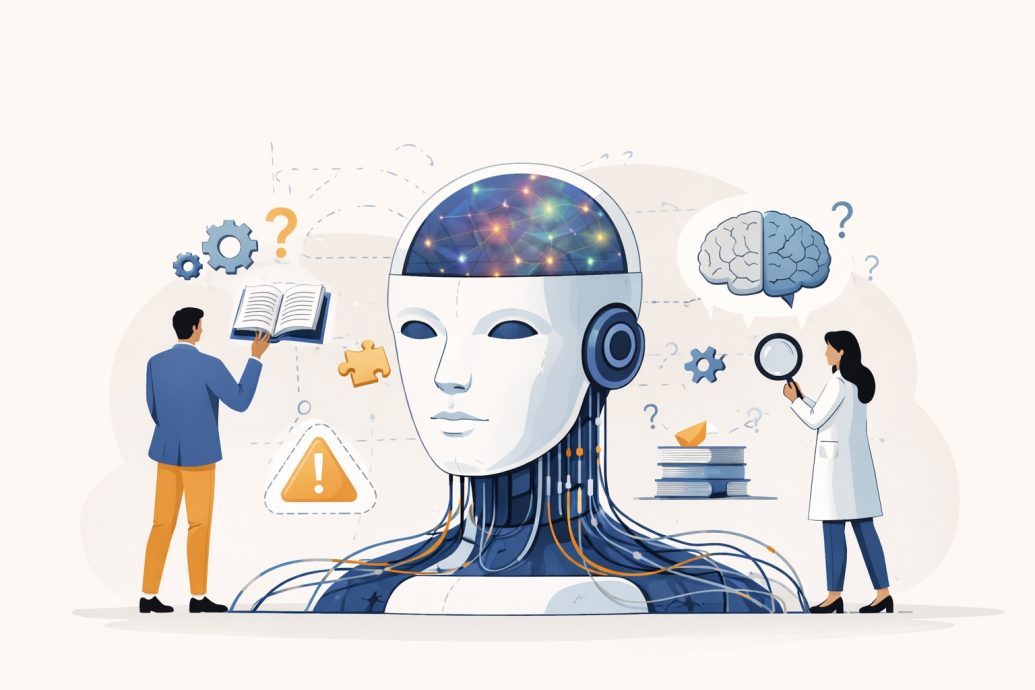

AGI Is Not Here: LLMs Lack True Intelligence
Artificial intelligence systems now generate essays, write code, summarize research, and answer complex questions. These capabilities have led many observers to claim that artificial general intelligence may already exist. Yet most AI researchers strongly disagree with that conclusion. According to the Stanford AI Index Report, modern AI systems achieve impressive results on benchmarks but still fail at tasks requiring deeper reasoning and real world understanding. The rise of large language models has created powerful tools, but these systems remain fundamentally different from human intelligence. Understanding why AGI is not here requires examining how language models work and where their limitations appear.
Key Takeaways
• Large language models generate fluent language but rely on statistical prediction rather than true understanding.
• Artificial general intelligence would require flexible reasoning, learning, and knowledge transfer across domains.
• Current AI systems struggle with logical consistency, long term memory, and real world grounding.
• Researchers believe breakthroughs in cognition, learning efficiency, and world modeling are required before AGI becomes possible.
Understanding Why AGI Is Not Here
What is Artificial General Intelligence?
Artificial general intelligence refers to a machine that can perform any intellectual task that humans can perform. Such a system would demonstrate reasoning, planning, problem solving, learning, and adaptability across many different domains. Unlike narrow AI systems, AGI would not require retraining every time it encounters a new problem.
Modern AI systems such as GPT models, Gemini, Claude, and Llama are examples of narrow AI. They specialize in tasks involving language processing and pattern recognition. These systems can perform extremely well within the boundaries of their training data. However, they cannot independently reason about the world in the same way humans do.
Many researchers emphasize that language ability alone does not equal intelligence. Humans combine language with perception, reasoning, memory, and interaction with the physical world. Current AI systems operate primarily within digital text environments. This limitation restricts the depth of understanding they can achieve.
One thing that becomes clear in practice is that fluent language can easily create the illusion of intelligence. The ability to produce convincing sentences does not guarantee that a system truly understands what it is saying.
How Large Language Models Actually Work
How do LLMs generate responses?
Large language models are neural networks trained to predict the next word in a sequence of text. They analyze enormous datasets containing books, research papers, websites, and other documents. Through training, the model learns statistical relationships between words and concepts.
The architecture that powers most language models is called the transformer. This design was introduced in a 2017 research paper titled “Attention Is All You Need.” Transformers use attention mechanisms that evaluate relationships between words across long contexts. This architecture enables models to capture complex linguistic patterns across billions of examples.
During training the model adjusts billions of internal parameters to reduce prediction errors. When given a prompt, the system calculates probabilities for possible next tokens and generates the most likely sequence of words. Techniques such as reinforcement learning from human feedback help refine responses so they better match human expectations.
A common mistake I often see is assuming that these systems reason through problems step by step. In reality, the model predicts plausible text patterns based on statistical associations learned during training. The reasoning that appears in responses often reflects patterns present in training data rather than genuine analytical thinking.
Critical Capabilities Missing From Current AI Systems
Several cognitive abilities remain absent in current language models. These limitations explain why researchers argue that AGI has not yet been achieved.
First, LLMs struggle with consistent logical reasoning. They may solve complex reasoning problems under certain conditions but fail when the wording changes slightly. Human reasoning tends to remain stable across similar contexts.
Second, language models lack grounded understanding of the physical world. Humans develop internal models of reality through sensory experience and interaction with environments. AI models trained only on text lack this experiential grounding.
Third, LLMs do not possess persistent long term memory. Each interaction typically starts from scratch without maintaining a continuous evolving knowledge base. Humans build memories and update beliefs over time.
Fourth, machine learning systems require enormous datasets and computational resources to learn new capabilities. Humans can learn many concepts from only a few examples. This difference highlights the efficiency gap between biological and artificial intelligence.
What many people underestimate is how complex human cognition truly is. Intelligence emerges from the interaction of perception, memory, reasoning, emotion, and social learning. Replicating this system remains one of the most difficult scientific challenges.
Case Studies Revealing the Limits of Language Models
Case Study: Mathematical Reasoning Experiments
Researchers from the University of Washington evaluated language models on advanced mathematics problems. The models sometimes produced correct answers after extensive prompting strategies. However, slight changes to the wording of the problems caused the systems to fail. This instability suggested the models relied on pattern recognition rather than reliable reasoning.
Case Study: Commonsense Knowledge Tests
MIT researchers tested language models using commonsense reasoning tasks involving everyday physical situations. Questions involved simple scenarios such as objects falling, containers holding liquids, or cause and effect relationships. Models frequently produced explanations that sounded plausible but contradicted basic physics principles.
Case Study: Hallucination in AI Systems
Researchers from Stanford documented numerous examples where language models generated fabricated academic citations or incorrect historical facts. The systems produced confident responses even when the information was wrong. This behavior occurs because models optimize for plausible language rather than factual accuracy.
In my experience, these experiments highlight the difference between performance and understanding. Language models can appear intelligent while lacking genuine conceptual reasoning.
The Real Economic Value of Large Language Models
Although LLMs lack general intelligence, they still provide enormous economic value. Organizations across many industries use language models to automate repetitive cognitive tasks.
Companies such as Microsoft, OpenAI, Google, Anthropic, and Meta AI continue investing billions of dollars in generative AI systems. These technologies power customer support assistants, programming tools, research summarization systems, and enterprise productivity software.
According to the McKinsey Global Institute, generative AI could contribute up to $4.4 trillion annually in global productivity improvements. Businesses already use AI to analyze documents, generate marketing content, and assist with software development workflows.
What many people underestimate is how transformative narrow AI can be. Even without achieving AGI, specialized AI systems can dramatically improve productivity across industries. The key lies in deploying these tools alongside human expertise rather than replacing human decision making.
Misconceptions About AGI and AI Intelligence
One widespread misconception is that passing exams or benchmarks proves intelligence. Language models sometimes perform well on professional exams such as law or medical tests. However, these evaluations measure knowledge recall rather than flexible reasoning across contexts.
Another misunderstanding suggests that scaling model size will inevitably produce artificial general intelligence. Increasing parameters and training data improves performance but does not automatically produce deeper cognitive capabilities. Many researchers believe new architectures will be necessary.
A third misconception involves the belief that language models possess consciousness or awareness. Current AI systems operate as mathematical functions mapping inputs to outputs. There is no evidence that they experience subjective awareness or emotions.
Understanding these misconceptions helps clarify the current state of AI development. Language models represent powerful computational tools rather than autonomous intelligent agents.
What True AGI Might Require
Achieving artificial general intelligence will likely require several scientific breakthroughs. Researchers studying cognition highlight a few capabilities that future systems must develop.
First, AGI systems must demonstrate reliable reasoning and planning abilities. They should analyze complex problems, develop strategies, and adapt to new situations without extensive retraining.
Second, future AI may require interaction with environments rather than training solely on text. Robotics platforms, simulations, and embodied learning environments could provide experiential data necessary for deeper understanding.
Third, efficient learning remains essential. Humans can learn new skills from minimal examples and apply them across domains. Machine learning systems currently require enormous datasets and computational resources.
One thing that becomes clear in practice is that AGI will likely emerge from interdisciplinary research. Advances in neuroscience, robotics, cognitive science, and computer science will likely converge before machines reach truly general intelligence.
FAQ
Is AGI real today?
Artificial general intelligence does not exist yet according to most AI researchers. Current systems such as GPT models and other large language models remain narrow AI tools. They perform specific tasks well but lack general reasoning abilities. True AGI would demonstrate flexible intelligence across many domains. Researchers continue working toward this goal.
Are large language models intelligent?
Large language models display impressive language generation capabilities. However, they rely on statistical prediction rather than genuine understanding. These systems analyze patterns in massive datasets and generate likely word sequences. The outputs can appear intelligent but do not reflect deep reasoning processes.
Why do people think AGI already exists?
The ability of language models to generate humanlike text can create the illusion of intelligence. When systems answer questions or produce essays, they appear to reason like humans. Many observers interpret these behaviors as evidence of general intelligence. Researchers explain that these results arise from pattern prediction rather than true cognition.
What is the difference between AI and AGI?
Artificial intelligence refers broadly to computer systems that perform tasks requiring humanlike capabilities. Artificial general intelligence refers specifically to systems capable of performing any intellectual task humans can perform. Current AI systems remain specialized tools designed for particular applications.
Why do AI models hallucinate?
Hallucinations occur when language models generate incorrect or fabricated information. The system attempts to produce coherent text even when reliable information is unavailable. This behavior results from the statistical nature of language modeling. Researchers continue developing methods to reduce hallucination rates.
Can scaling models lead to AGI?
Increasing model size has improved performance across many benchmarks. Larger models often generate more accurate responses and demonstrate broader capabilities. However, most researchers believe scaling alone will not produce general intelligence. Additional breakthroughs in reasoning and learning architectures may be required.
Do language models understand meaning?
Most experts argue that language models do not truly understand meaning. They process statistical relationships between words rather than conceptual knowledge. Human understanding involves sensory experiences and real world context. Language models lack these forms of grounding.
Are AI systems conscious?
Current AI systems are not conscious or self aware. They operate as mathematical algorithms that process inputs and generate outputs. Consciousness remains a poorly understood phenomenon even within neuroscience. There is no scientific evidence that modern AI systems possess awareness.
What breakthroughs might lead to AGI?
Future progress toward AGI may involve advances in reasoning architectures, world modeling, and embodied learning systems. Robotics platforms may allow AI systems to learn through physical interaction. Neuroscience research could also influence new computational models of intelligence.
Will AGI replace human workers?
The long term impact of AGI remains uncertain. Current AI systems primarily assist human workers rather than replace them entirely. Many industries benefit from AI tools that augment productivity and automate repetitive tasks. Future economic effects will depend on technological progress and policy decisions.
When might AGI appear?
Experts disagree widely on timelines for artificial general intelligence. Some researchers predict it could emerge within decades. Others believe it may require far longer due to fundamental scientific challenges. Predicting timelines remains difficult because intelligence itself is not fully understood.
Why is human intelligence difficult to replicate?
Human cognition involves complex interactions between perception, reasoning, emotion, memory, and social learning. These processes evolved over millions of years within biological systems. Replicating them in machines requires breakthroughs across many scientific disciplines.
Conclusion
Large language models represent one of the most important technological developments in modern computing. They enable powerful applications in writing, research, coding, and knowledge analysis. Yet these capabilities should not be mistaken for artificial general intelligence. Current systems rely on statistical prediction rather than genuine reasoning and understanding.
Recognizing this distinction helps society maintain realistic expectations about AI progress. Continued research in machine learning, cognitive science, and neuroscience will determine whether machines eventually achieve general intelligence. Until then, language models remain powerful tools rather than truly intelligent agents.
References
Bubeck, Sébastien, et al. “Sparks of Artificial General Intelligence: Early Experiments with GPT-4.” arXiv, 2023, https://arxiv.org/abs/2303.12712.
McKinsey Global Institute. The Economic Potential of Generative AI: The Next Productivity Frontier. McKinsey and Company, 2023, https://www.mckinsey.com/capabilities/mckinsey-digital/our-insights/the-economic-potential-of-generative-ai.
Stanford Institute for Human Centered Artificial Intelligence. AI Index Report 2024. Stanford University, https://aiindex.stanford.edu.
Vaswani, Ashish, et al. “Attention Is All You Need.” Advances in Neural Information Processing Systems, 2017, https://arxiv.org/abs/1706.03762.
Mitchell, Melanie. Artificial Intelligence: A Guide for Thinking Humans. Farrar, Straus and Giroux, 2019.